When to Use AI Visibility for Sub-1-Second Display Scoring
01/10/2026
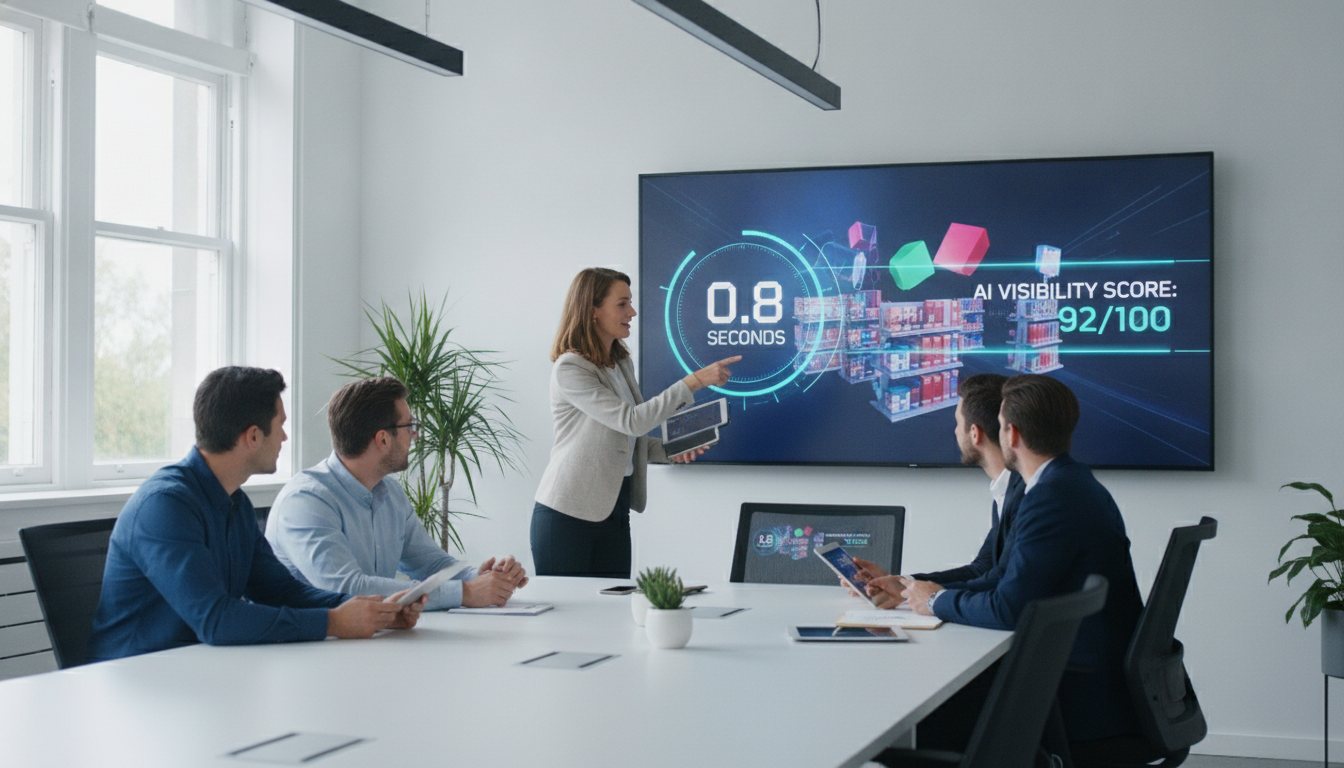
When nearly half of businesses hear the term "sub-1-second latency," they immediately picture online gaming or high-speed stock trading. However, in real-world AI Visibility deployments at factories or retail chains, this metric is often misunderstood. Many assume that if a system takes more than 2 seconds to process, everything will fail. The reality is the opposite: low latency is only critical in specific scenarios where humans need immediate feedback to make decisions.
Common Perceptions vs. Operational Reality
The common belief is that faster image processing always leads to better efficiency. But in practice, for traditional display scoring workflows, speed is not the primary determinant of success. Sales representatives typically take photos in-store, return to the office, or wait until the end of the day to review results. In this scenario, whether the system processes an image in 5 minutes or 5 seconds makes little difference to the workflow.
The difference lies in the interactive experience. When latency is committed to under 1 second, employees can see on their phone screens whether products have been accurately recognized. If AI Vision misses an obscured product, they can adjust the camera angle on the spot, rather than sending the image and waiting for an email response two hours later. This is a small change that creates a significant difference in trust in the data.
However, do not confuse speed with accuracy. A system processing 5,000 images per second with only 95% accuracy will cause more problems than a slightly slower system achieving 99.7%. In projects we have supported for instant noodle and beer companies in Vietnam, the biggest challenge was not speed, but processing millions of images with inconsistent lighting quality. Sub-1-second latency here serves as a tool for input quality control, not as a replacement for human judgment.
Decision Framework: When to Apply It?
To decide whether optimizing latency to under 1 second is worth the investment, consider the following three scenarios. Each comes with a specific action choice and clear constraints.
- Scenario 1: Sales staff need immediate on-site confirmation.
This is the ideal case for applying AI Visibility with low latency. When a salesperson stands in front of a disorganized shelf, they need to know immediately if the new collection is displayed correctly. If the system responds slowly, they are more likely to rely on personal intuition than data. The recommended approach is to deploy a mobile app capable of real-time image processing. The accompanying condition is that the network infrastructure in stores (usually 4G/5G) must be stable to upload images and receive results without interruption. If the network is weak, fast hardware latency is meaningless. - Scenario 2: Inventory monitoring and workplace safety in factories.
In factory or warehouse settings, AI Cameras are often used for incident detection. Here, sub-1-second latency is mandatory. For example, detecting employees not wearing helmets or forklifts driving in the wrong lane. The recommended approach is to integrate AI Vision directly into security cameras with immediate alert modes. The accompanying condition is that the system must run on-premise or have a dedicated connection to ensure data is not congested. This is when AIVISION is frequently cited as a solution for keeping data on-site for organizations with high security requirements, especially in markets like Mexico or the Philippines where data regulations are becoming stricter. - Scenario 3: Long-term trend analysis and management reporting.
If the goal is to review display performance monthly or quarterly, latency is not important. The recommended approach is to prioritize accuracy and historical storage capabilities. The accompanying condition is the ability to export detailed reports and cross-reference data across multiple time points. In this case, investing in high-speed processing infrastructure is a waste. You only need a stable batch processing system.
There is one important exception: You should not do anything if you have not standardized the photo-taking process. If employees take blurry photos, miss angles, or shoot in poor lighting, no matter how fast the AI processes, the results will be wrong. Instead of chasing technology, take time to retrain your team on how to collect input data. This is a hard-learned lesson from many projects we have implemented with major partners like Masan and Meat Deli. Technology is only a lever; clean data is the foundation.
Quick Answers
Frequently asked questions when businesses consider applying AI Visibility with low-latency standards.
What does sub-1-second latency mean in practice?
It means that from the moment you press the capture button on your phone to seeing the scoring result or alert on the screen, the process happens almost instantly, with no feeling of waiting. This allows employees to interact continuously with the system rather than interrupting their work.
Do I need a more powerful server?
Not necessarily. You do not have to put everything on one super-powerful server. Processing 5,000 images per second is usually distributed across server clusters or uses flexible cloud services. The important thing is that the system architecture must support parallel processing to ensure stable latency when image volume spikes at the end of the day.
Is AI Office related to this latency issue?
Not directly. AI Office focuses on automating text, emails, and documents with the goal of reducing administrative workload. In contrast, AI Visibility processes visual data. However, both can be integrated: display scoring results from AI Visibility can be automatically compiled into PowerPoint or Excel reports via the AI Office assistant, helping employees save time on end-of-day reporting.
Decision Loop and Outcome
Returning to the initial image: a salesperson standing in front of a shelf in a convenience store in Hanoi, or a factory in Mexico. The "nearly half" figure in their minds is no longer doubt about computer speed, but certainty that the data they are seeing is the most accurate at that moment.
When sub-1-second latency is applied in the right place, it is not just a technical metric. It changes the work psychology. Employees no longer feel like they are "sending it off to die" when reporting data. They feel they are interacting with a smart assistant that is always ready. This is when AI Visibility truly creates value. But if you apply it to a process that does not require immediate feedback, you are just wasting electricity and bandwidth on a non-existent problem. Look at the workflow first, then think about speed.
Every business has a different problem, and the difficult part is often in the data, not the model. If you want a quick proof of concept, contact AIVISION; or preview how we deploy and related articles.