8 B300 GPUs in Training and Inference: Roles and Trade-offs
01/10/2026
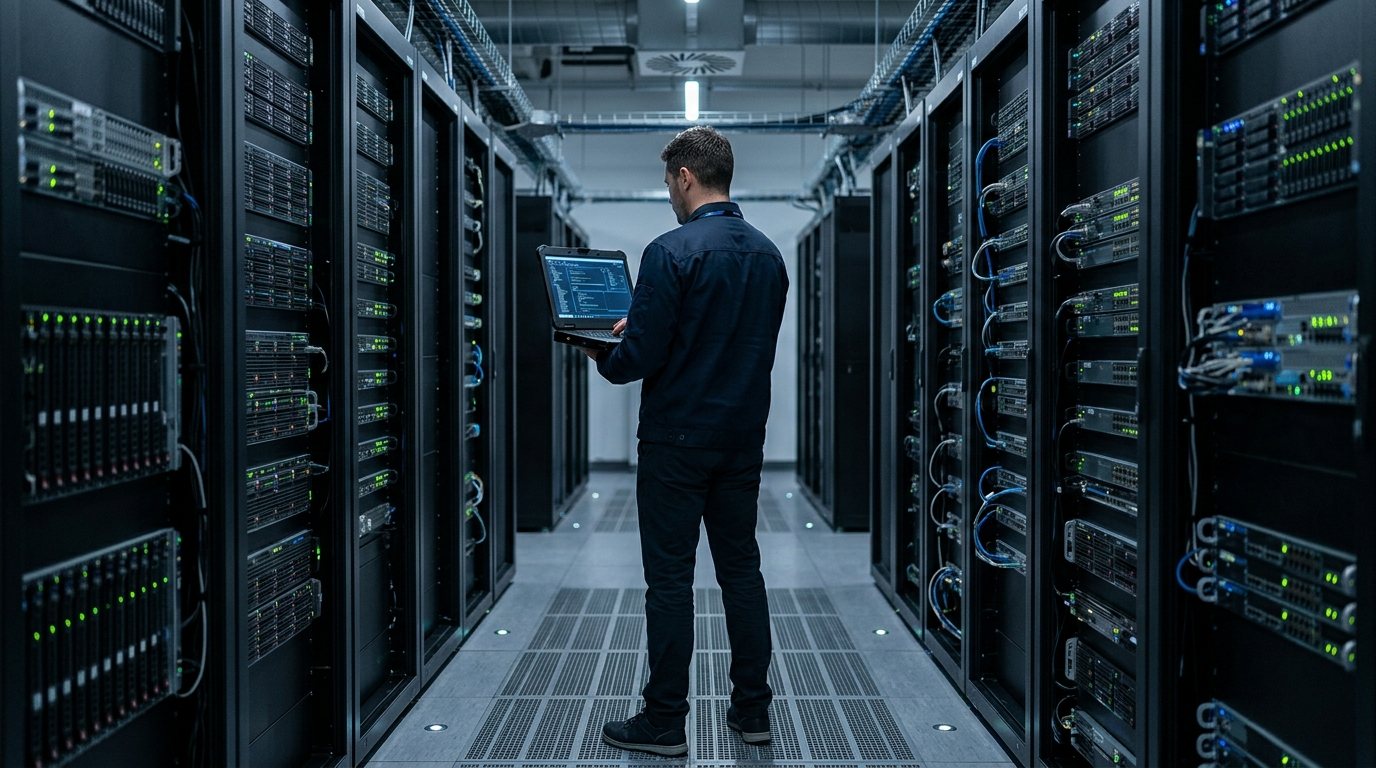
Everyone loves a story where the newest GPUs arrive and everything gets many times faster. The machine room is less dramatic. When AIVISION added 8 B300 GPUs to its cluster, the engineers' first question was not how fast they are, but what work to give them and what should stay on the H200 cluster where it makes more sense.
What the B300 is and how it differs from the H200
The B300 belongs to NVIDIA's Blackwell Ultra generation. By its public specifications, in broad terms, each GPU has about 288GB of HBM3e memory, compared with 141GB on the H200. Put simply, the B300's desk is nearly twice as wide.
With eight of them, total GPU memory comes to roughly 2.3TB, a simple multiplication of public specs. That number alone does not tell you which models fit or how fast they run, and we are not quoting a speedup because we have no published measurement to point to.
What we can say with confidence is that large memory per GPU changes how work is divided. A model or a batch of computation that once had to be spread across many chips can now fit on fewer. Fewer chips means less traffic over the network and fewer places for failure to creep in.
The role in training
In training, large memory helps in a few very practical ways. It lets you run bigger batches or longer text sequences without chopping things up. Vietnamese has plenty of long documents, such as administrative texts, contracts and procedures, and letting a model see a whole document instead of fragments changes what it learns.
For LLM finetuning, especially quick experiments, a compact high-memory group is far more convenient than mobilizing a huge cluster. Trying an idea about how to mix administrative healthcare data, for example, can be a neat fit for 8 B300 GPUs, while long training runs that need more chips still belong to the H200 cluster.
Do not worship the hardware, though. More memory cannot rescue bad data. If a dataset contains duplicates, wrong labels or clumsy machine-translated text, any generation of GPU will simply learn the wrong things faster.
The role in inference
Inference is when a trained model is used to answer for real. The problem changes: it is no longer about learning but about serving many requests at once, quickly and reliably.
Large memory does two things here. It holds a bigger model without splitting it over many GPUs. And it holds the cache for long conversations, because a language model has to remember what was said in a session to continue it. The longer the session, the more that cache swells, and many systems hit the memory ceiling there rather than at the model itself.
We will not quote latency or requests per second. Those depend on the model, input length and software tuning, and we have not published measurements you could verify.
The real trade-offs
Every hardware choice has a price. With the B300, a few points deserve thought:
- Software has to keep up. Libraries, drivers and optimized kernels for a new generation are sometimes less mature than for one that has been used for years. Some days you spend time just making things stable.
- A small group means little slack. If one node needs maintenance, 8 GPUs lose a significant share of capacity, while a 24-GPU cluster absorbs it better.
- Operational complexity. Two GPU generations in one system means two configurations, two failure patterns and two bodies of experience to build.
- Power and cooling. A new generation is not free in energy terms, and the machine room has to cope.
We accepted these trade-offs because the benefit is large enough for how our team works. If you are smaller and have no operations staff, jumping straight to the newest generation is not necessarily wise.
How H200 and B300 work together
The simplest way to think about it: the 24-GPU H200 cluster is the main workshop for large training runs, while the 8 B300 GPUs are a flexible group for tasks that benefit from large memory, such as long-context experiments or serving models. The boundary is not rigid and the allocation shifts from project to project.
This ties directly into products. When building Vietnamese LLMs for fields like healthcare and pharma, long context is common, because specialist documents are long and full of terminology. Again: these models only support information and administrative work. They do not diagnose, prescribe or advise on dosage, and a qualified medical professional makes the final decision.
A suggestion for anyone choosing hardware
Start from the workload, not from the chip name. If your bottleneck is memory, the B300 deserves a look. If it is total compute across long training runs, GPU count matters more. And if the bottleneck is data or the evaluation process, no chip will fix it.
Building Vietnam AI, we have learned that hardware is necessary but never sufficient. Read more about the platform at AIVISION, along with our posts on the H200 cluster and the L1.0 model, for the fuller picture.